The Los Angeles Dodgers lead in Box-Toppers team rankings for the seventh consecutive week.
The New York Yankees maintain the lead among American League teams, while the Chicago Cubs earned the most points in the past week.
Read More
Blog
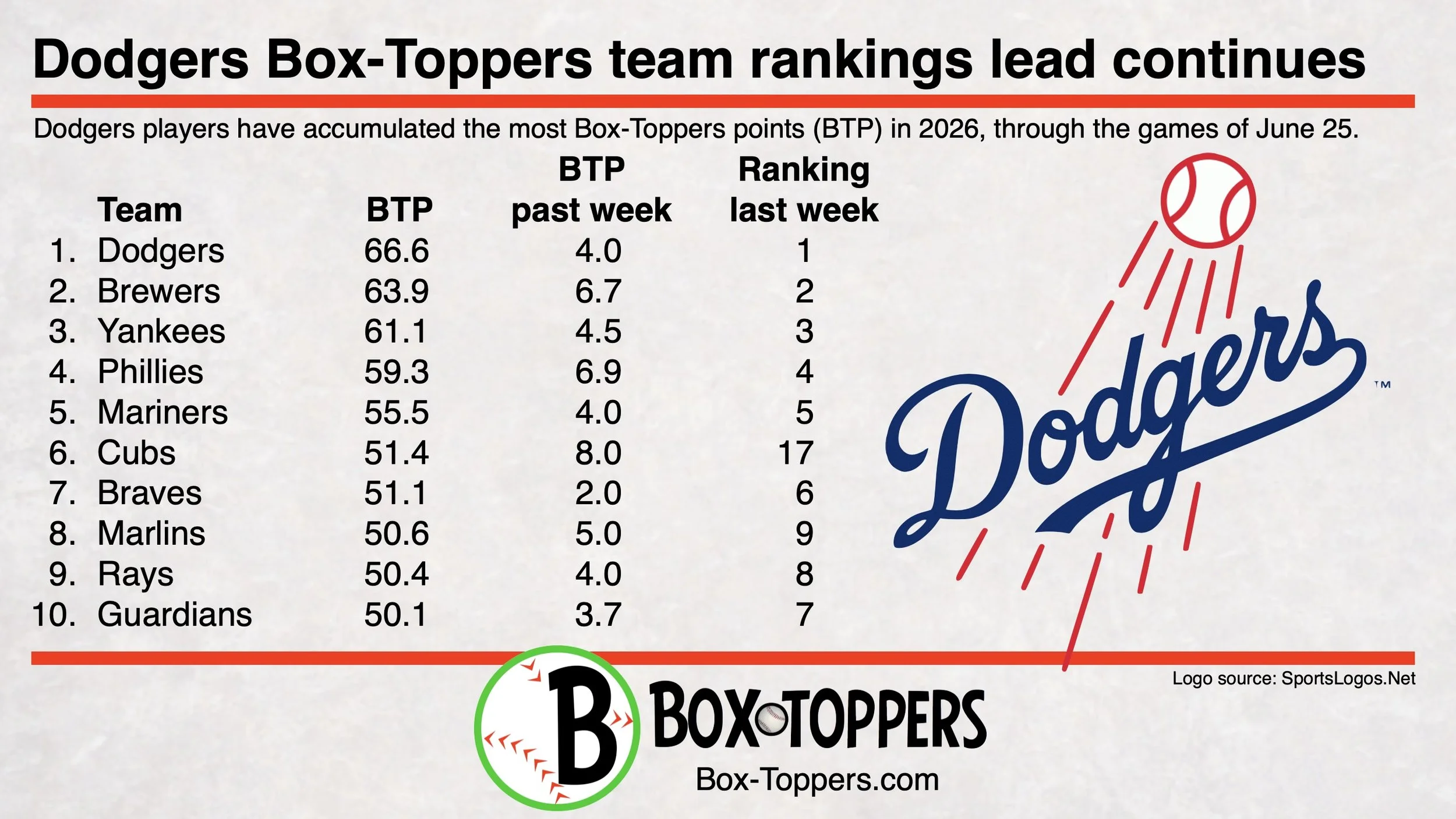
The Los Angeles Dodgers lead in Box-Toppers team rankings for the seventh consecutive week.
The New York Yankees maintain the lead among American League teams, while the Chicago Cubs earned the most points in the past week.
Read More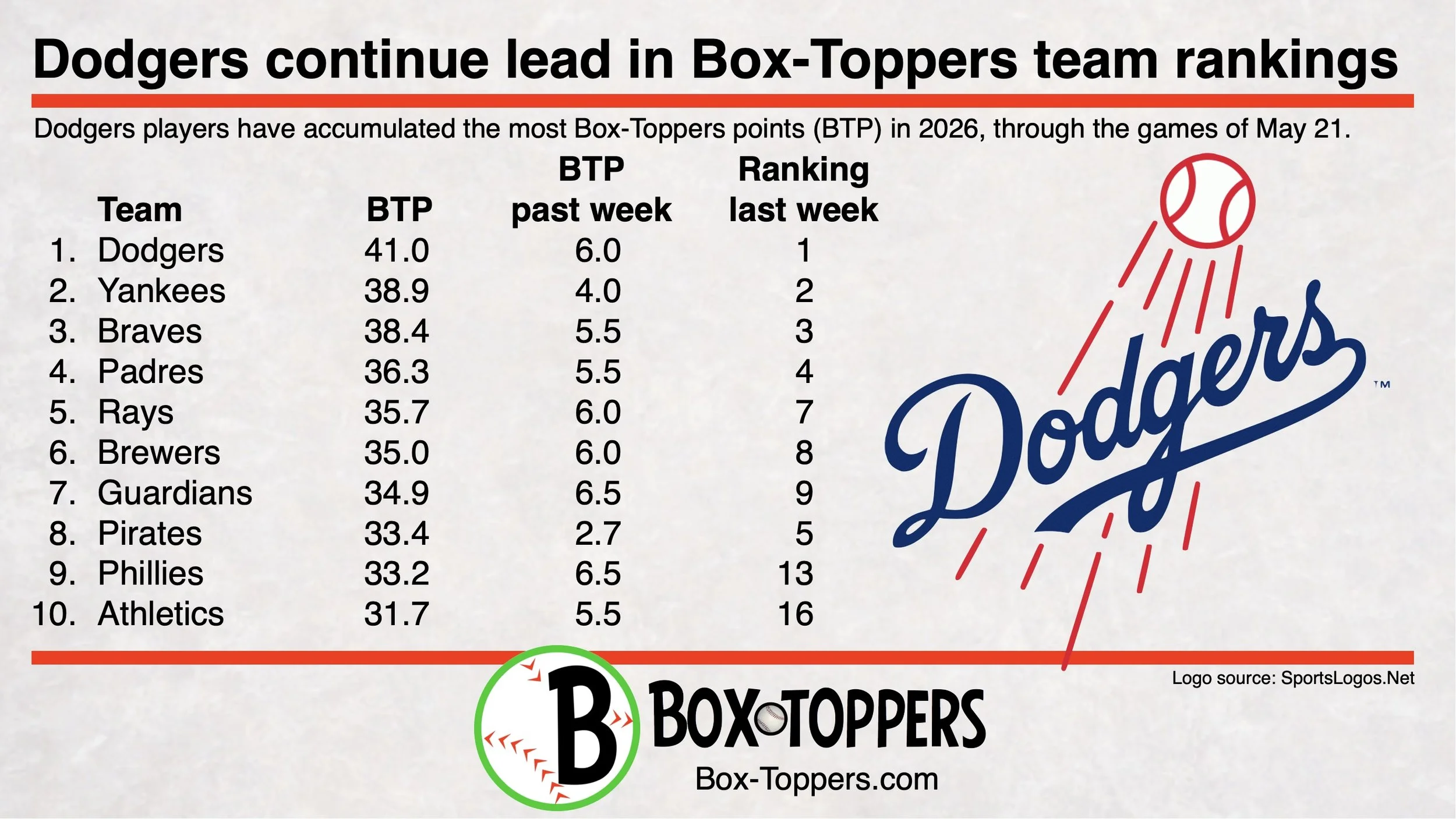
The Los Angeles Dodgers lead in Box-Toppers team rankings for the second week in a row.
| Teams | BTP | BTP/wk | Wk ago | |
|---|---|---|---|---|
| 1 | Dodgers | 41.0 | 6.0 | 1 |
| 2 | Yankees | 38.9 | 4.0 | 2 |
| 3 | Braves | 38.4 | 5.5 | 3 |
| 4 | Padres | 36.3 | 5.5 | 4 |
| 5 | Rays | 35.7 | 6.0 | 7 |
| 6 | Brewers | 35.0 | 6.0 | 8 |
| 7 | Guardians | 34.9 | 6.5 | 9 |
| 8 | Pirates | 33.4 | 2.7 | 5 |
| 9 | Phillies | 33.2 | 6.5 | 13 |
| 10 | Athletics | 31.7 | 5.5 | 16 |
| 11 | Cubs | 31.5 | 1.0 | 6 |
| 12 | Diamondbacks | 31.2 | 7.2 | 22 |
| 13 | Reds | 31.2 | 4.0 | 10 |
| 14 | White Sox | 30.4 | 4.2 | 15 |
| 15 | Cardinals | 30.2 | 3.0 | 11 |
| 16 | Mariners | 29.9 | 3.2 | 12 |
| 17 | Rangers | 29.6 | 4.4 | 17 |
| 18 | Nationals | 29.4 | 5.0 | 18 |
| 19 | Twins | 29.3 | 3.0 | 14 |
| 20 | Blue Jays | 28.1 | 4.7 | 23 |
| 21 | Marlins | 26.2 | 2.0 | 19 |
| 22 | Red Sox | 25.9 | 4.0 | 24 |
| 23 | Orioles | 25.1 | 1.0 | 20 |
| 23 | Royals | 25.1 | 1.0 | 21 |
| 25 | Mets | 23.5 | 5.5 | 30 |
| 26 | Astros | 23.3 | 3.0 | 27 |
| 27 | Giants | 23.3 | 2.0 | 25 |
| 28 | Rockies | 21.7 | 2.0 | 28 |
| 29 | Tigers | 21.5 | 1.0 | 26 |
| 30 | Angels | 20.5 | 1.0 | 29 |
The New York Yankees remain the top American League team, while the Arizona Diamondbacks are the week’s hottest team.
The Dodgers remain in first place overall with 41.0 Box-Toppers points, gaining 6.0 in the past week. They lead National League teams for the seventh straight week, ahead of the Atlanta Braves (38.4 points, third overall).
The Dodgers have baseball’s third-best winning percentage (.591), behind the Tampa Bay Rays (.688) and the Braves (.686). (The Rays are fifth in Box-Toppers team rankings with 35.7 points.)
Shohei Ohtani leads all Dodgers with 7.7 Box-Toppers points, earning 2.0 as a batter and 5.7 as a pitcher. He ranks sixth overall, first among NL batters and fourth among NL pitchers. Other key Dodgers players include pitcher Tyler Glasnow (5.7 points, 11th among NL pitchers) and Max Muncy (3.7 points, seventh among NL batters). Sixteen different Dodgers players have earned Box-Toppers points so far in 2026.
The Yankees lead AL teams for the sixth straight week with 38.9 Box-Toppers points, gaining 4.0 in the past week and maintaining second place overall. They lead AL teams ahead of the Rays (fifth overall with 35.7 points). While the Yankees lead in Box-Toppers points, the Rays hold the AL's best winning percentage (.688 to .588).
The Yankees are led by pitcher Cam Schlittler (7.7 points, fifth overall, second among AL pitchers). Yankees’ top batter is Trent Grisham (2.5 points, 15th among AL batters). Seventeen different Yankees players have earned Box-Toppers points so far in 2026.
The Diamondbacks gained 7.2 Box-Toppers points in the past week, most of any team, giving them 31.2 for the season, rising from 22nd to 12th place overall. That 10-spot jump is biggest among all teams this week. The Diamondbacks won six of their seven games this week.
The Cubs fell five spots in team rankings and gained only 1.0 point in the past week, winning just one of their six games. The Cubs fell from sixth to 11th place overall with 31.5 points.
The Angels fell from 29th to 30th and last place overall this week with 20.5 Box-Toppers points, picking up 1.0 in the past week.
The New York Mets, in last place the past four weeks, rise to 25th with 23.5 Box-Toppers points, picking up 5.5 in the past week.
Box-Toppers tracks who contributes most to their team’s victory. Using standard box score statistics, we identify the Player of the Game for every MLB contest. In the regular season, winners earn 1.0 Box-Toppers point, with bonus points awarded to the top overall and league-specific players of the day. More on how Box-Toppers works.
Help us stay accurate! Spot a mistake? Contact Box-Toppers here so we can fix it.
Follow us: Bluesky | X | Facebook | Substack (newsletter)
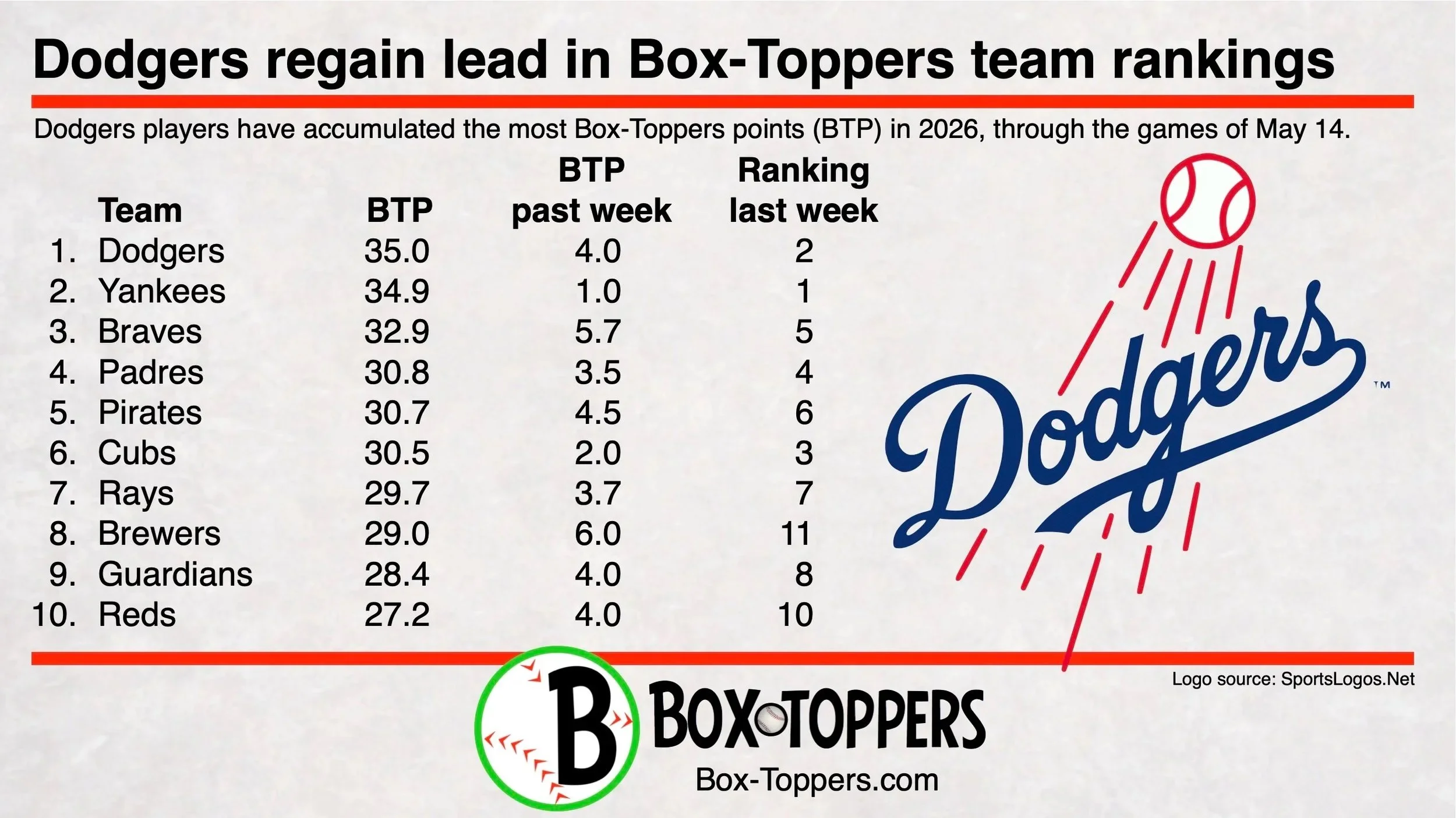
The Los Angeles Dodgers regain the lead in Box-Toppers team rankings one week after the New York Yankees passed them for the top spot.
The Yankees remain close on the heels of the Dodgers in second place and continue their lead among American League teams. Meanwhile, the Milwaukee Brewers are the week’s hottest team.
Read More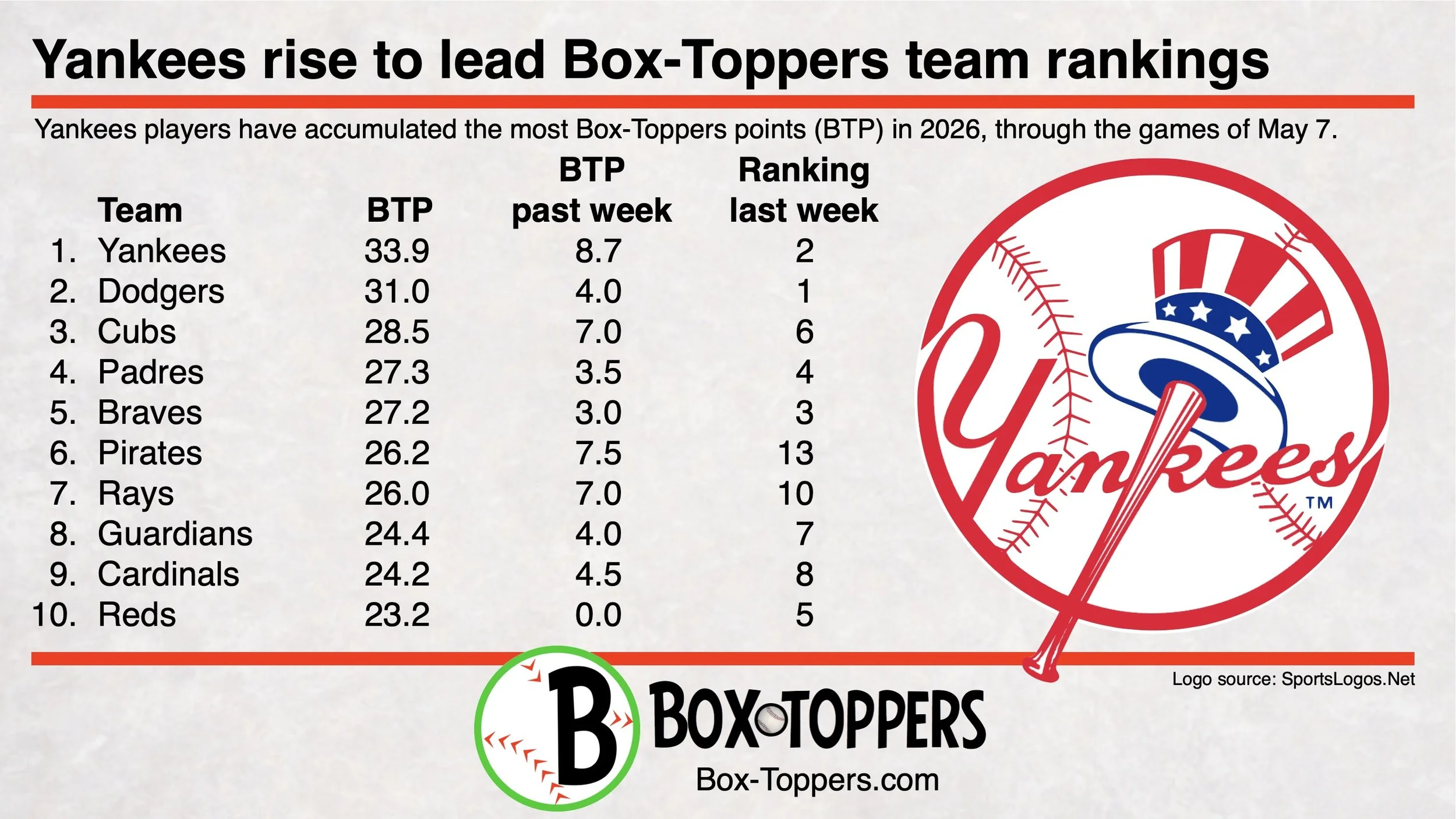
The New York Yankees rise to first place in this week’s Box-Toppers team rankings, overtaking the Los Angeles Dodgers after a week in which they gained a league-high 8.7 points.
Yankees lead
The Yankees rise from second place last week to first place this week. Yankees players have accumulated 33.9 Box-Toppers points this season, including 8.7 in the past week, most of any team.
Read More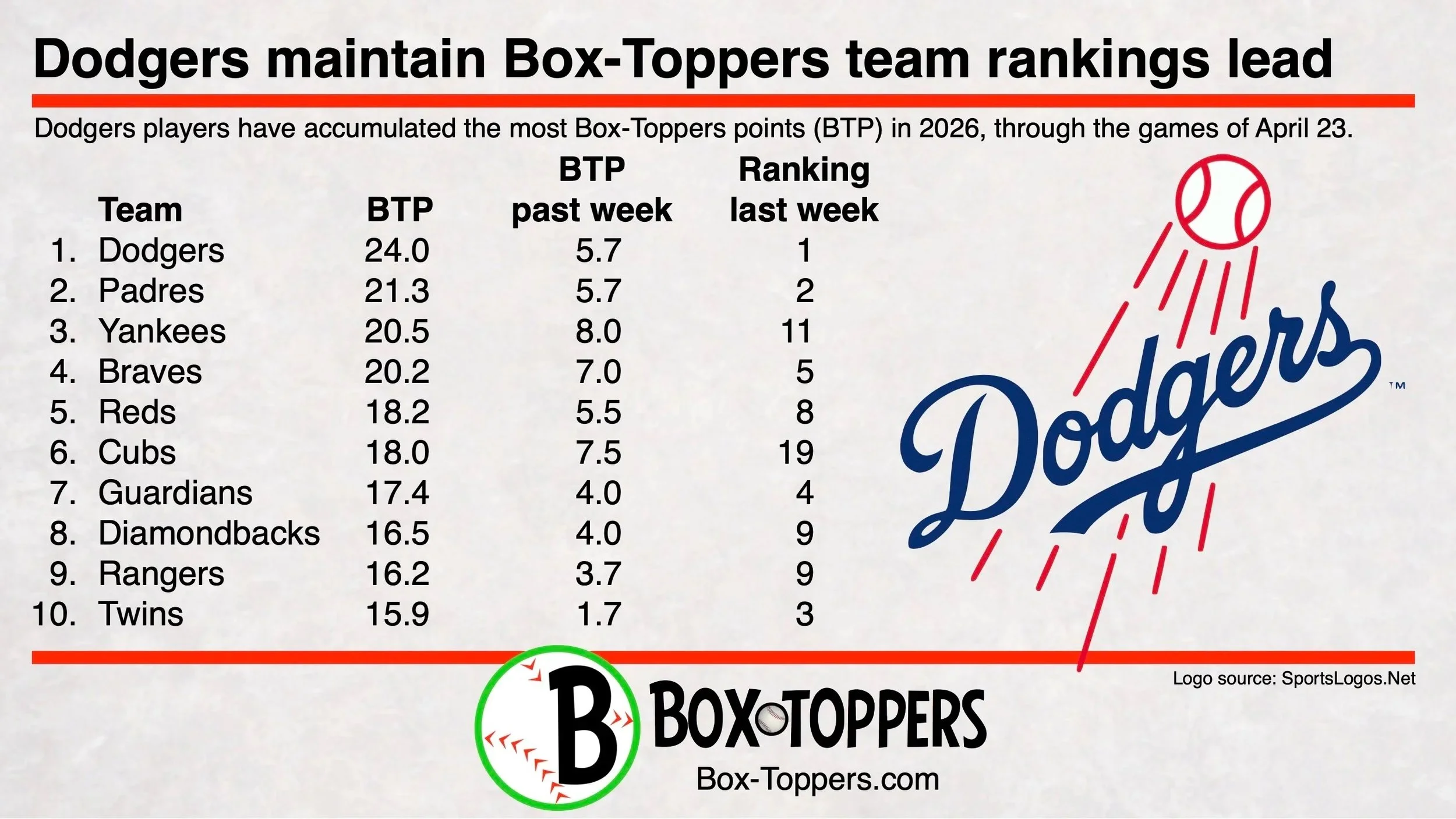
The Los Angeles Dodgers maintain first place in Box-Toppers team rankings for the third straight week.
The New York Yankees are the week’s hottest team, surging into the American League lead.
Read More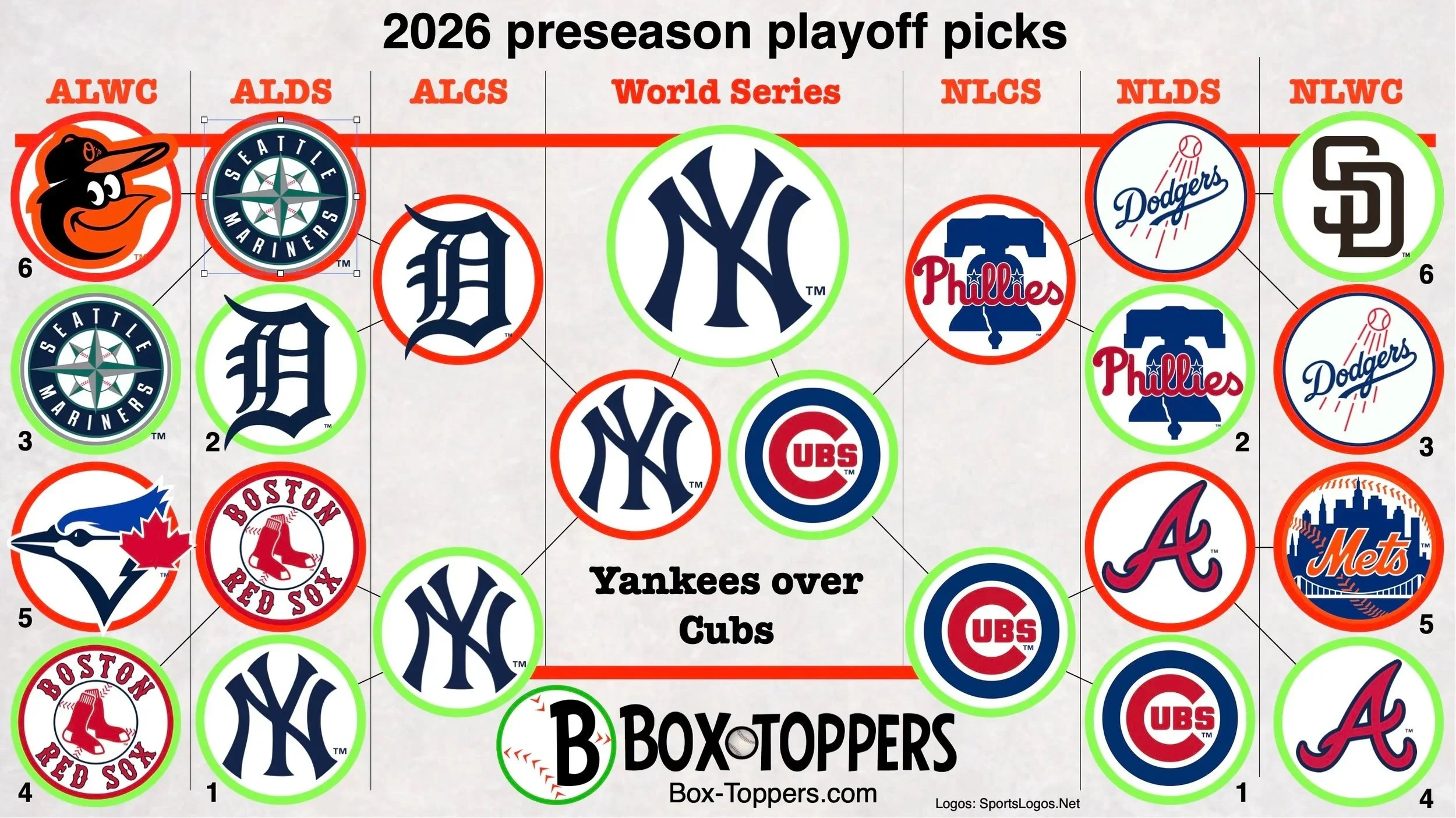
The New York Yankees are Box-Toppers’ pick to win the 2026 World Series, defeating the projected National League champion Chicago Cubs.
Box-Toppers projects the Yankees will win 100 games and the American League pennant, ahead of the Detroit Tigers, Seattle Mariners, and Boston Red Sox.
Read MoreVenezuela pitcher Eduardo Rodríguez is Box-Toppers Player of the Game in Tuesday’s World Baseball Classic Championship Game.
Rodríguez, who pitches for the Arizona Diamondbacks in Major League Baseball, struck out four over 4 1/3 scoreless innings, allowing one hit and one walk, in the 3-2 win over the United States.
Read More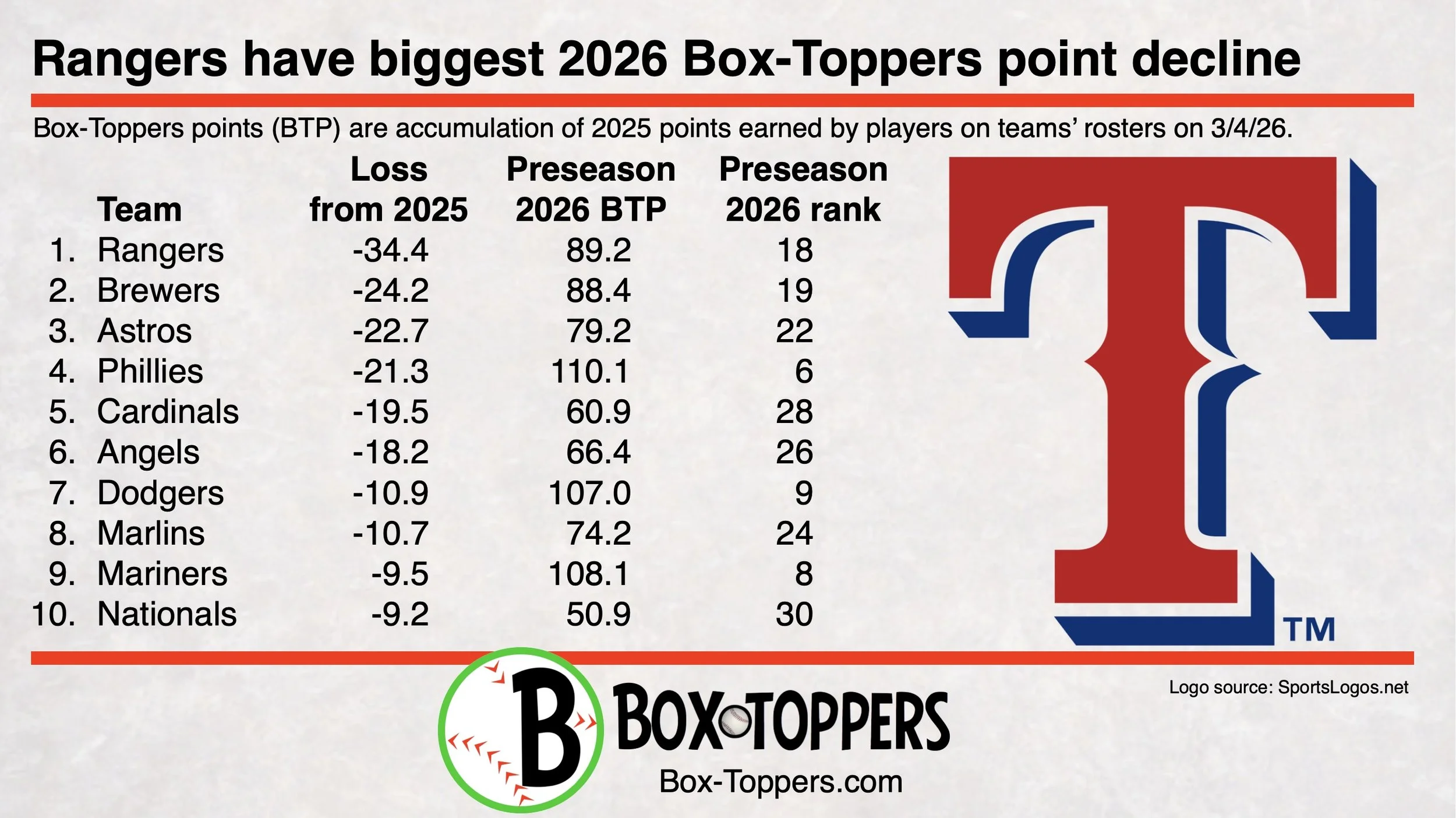
The Texas Rangers and Milwaukee Brewers have experienced the steepest declines in the league as we approach the 2026 season.
While both teams have seen their Box-Toppers rankings plummet, the reasons behind their slides are very different.
Read More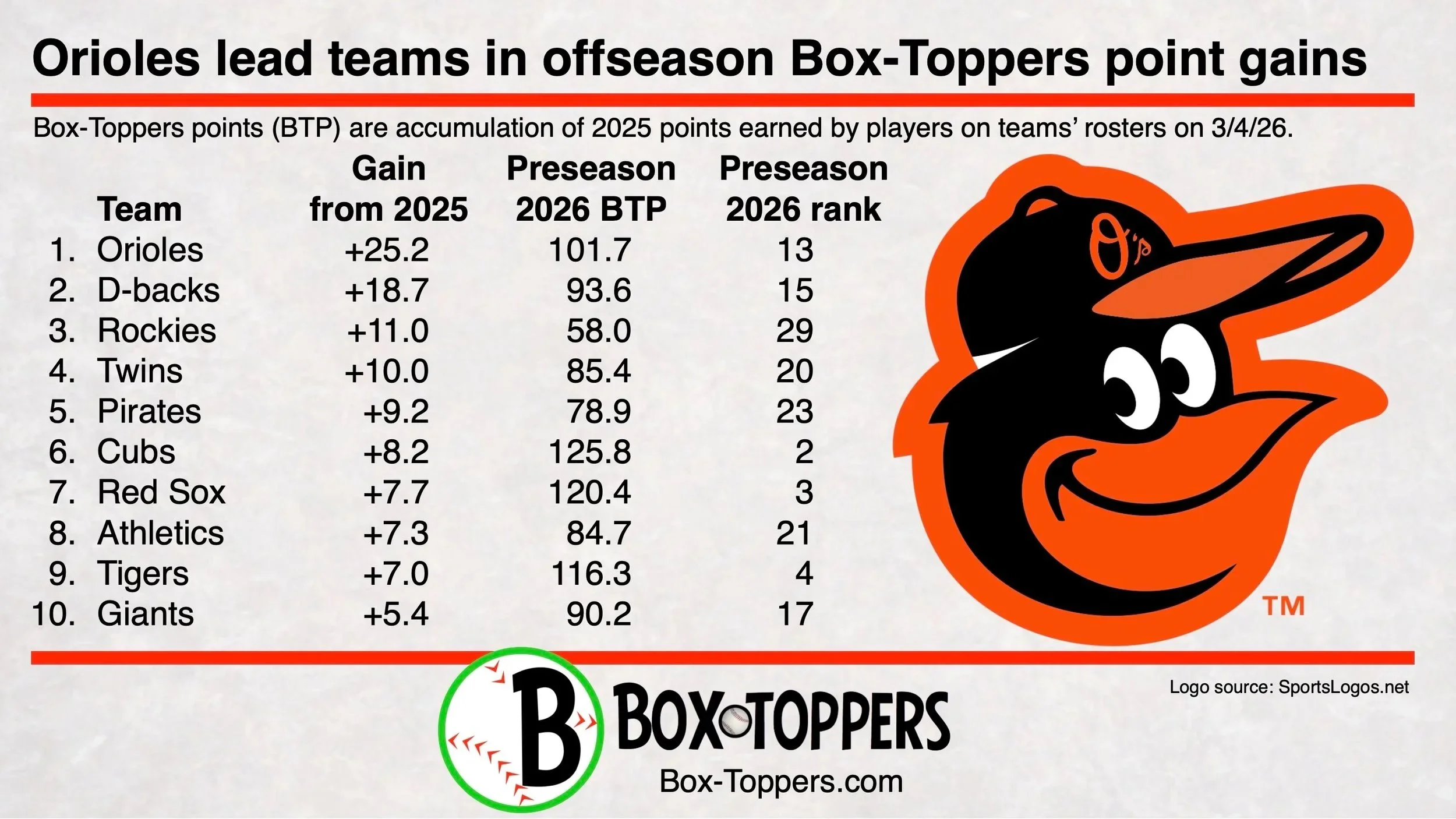
The Baltimore Orioles and Arizona Diamondbacks are Box-Toppers’ most improved teams as we head toward the 2026 baseball season.
Both clubs have surged 11 spots in the Box-Toppers rankings since the end of 2025—the largest jumps in the league—fueled by aggressive offseason acquisitions and key player returns.
Read More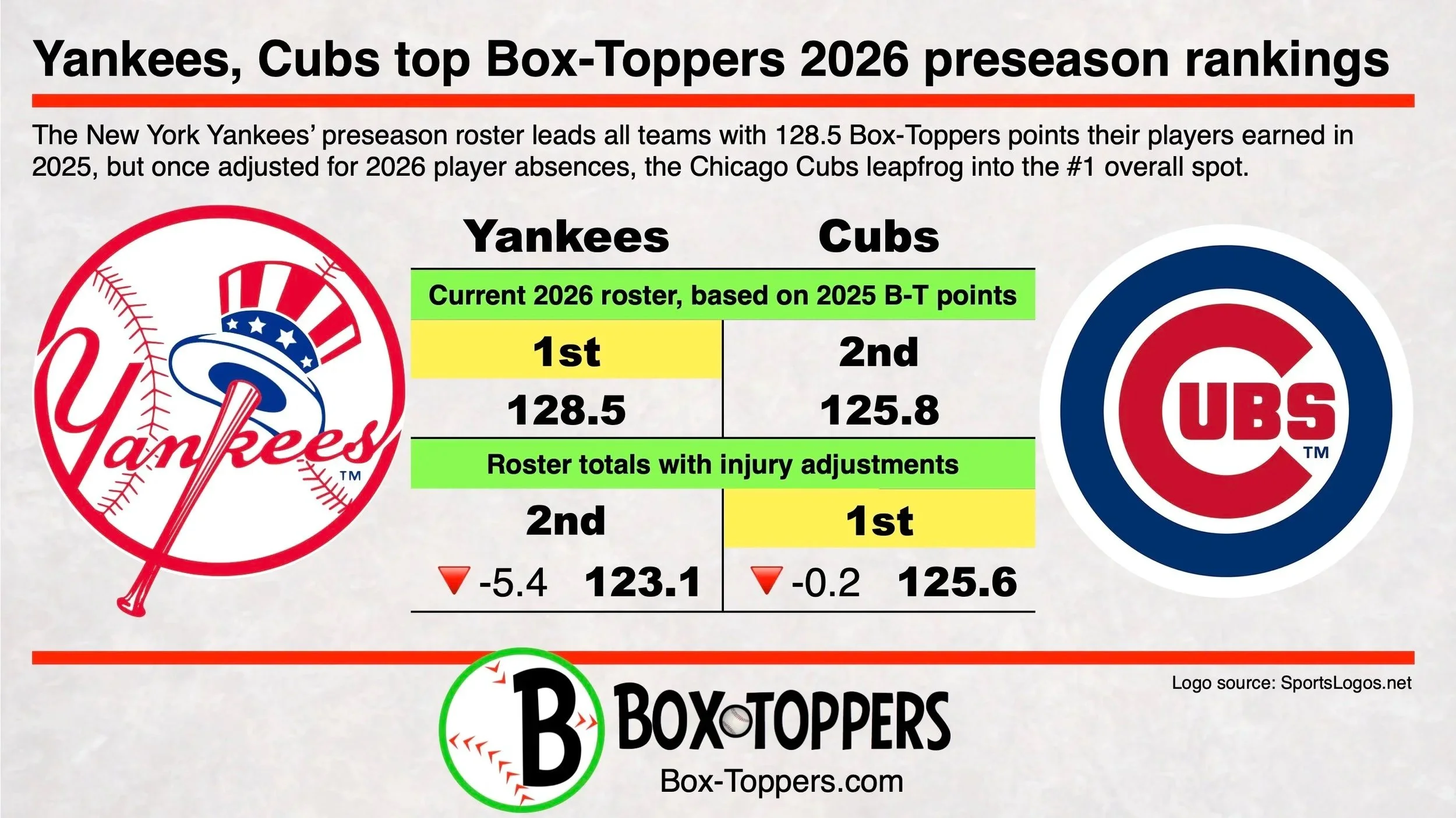
The New York Yankees enter 2026 as Box-Toppers’ top-ranked team, but their lead is a precarious one.
While the Yankees’ current roster combined for a league-leading 128.5 Box-Toppers points in 2025—narrowly edging out the Chicago Cubs (125.8 points)—the raw totals don't tell the whole story.
Read More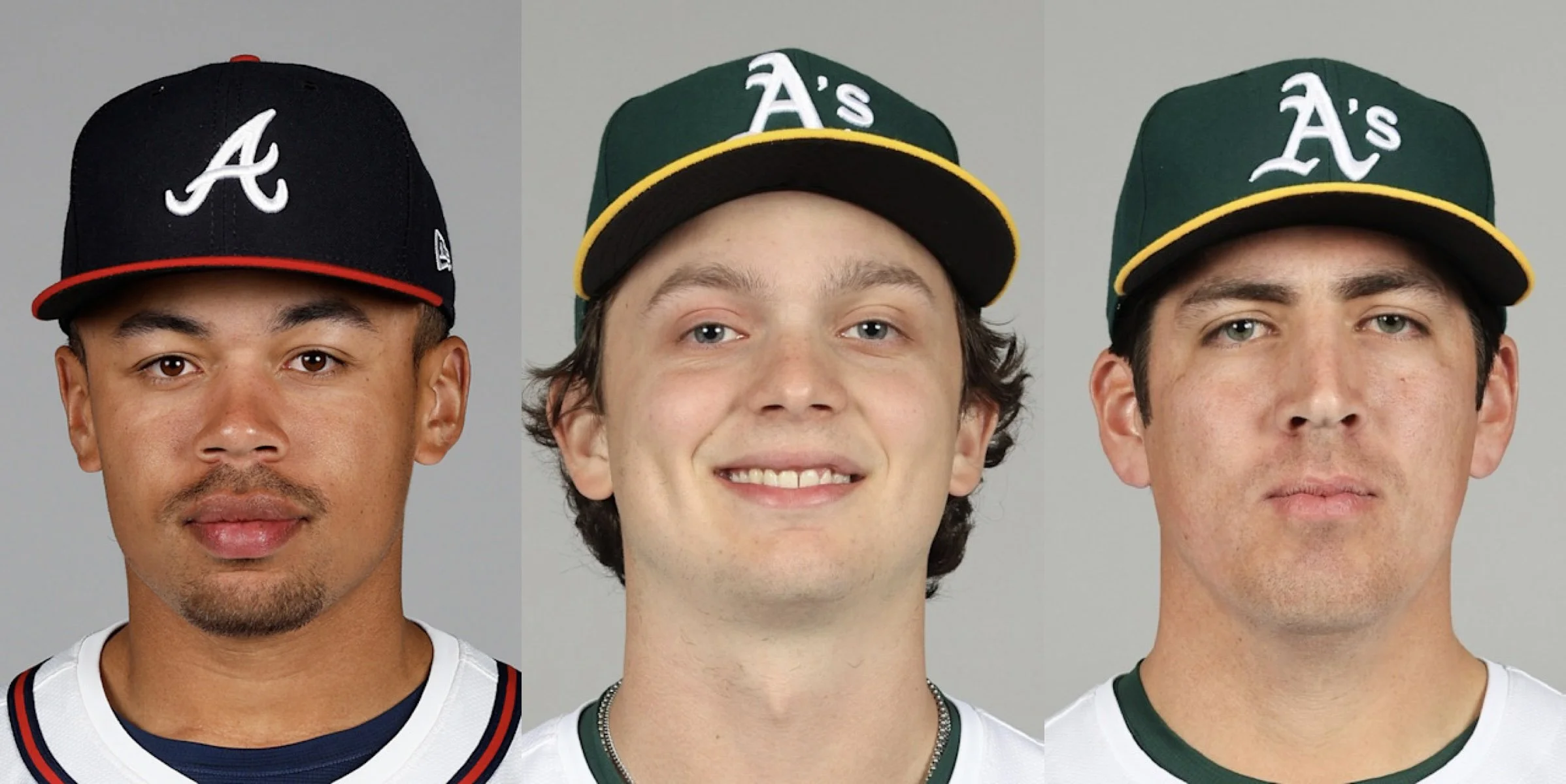
Among players on the Box-Toppers 2025 All-Rookie Team are rookie leaders in Box-Toppers points for the season: Drake Baldwin of the Braves, Nick Kurtz of the Athletics and Jacob Lopez of the Athletics.
Rookie of the Year winners for 2025—Braves catcher Drake Baldwin and Athletics first baseman Nick Kurtz—are among players on the Box-Toppers 2025 All-Rookie Team.
Baldwin was Box-Toppers’ choice for NL Rookie of the Year. While his 6.5 Box-Toppers points for the season trailed pitchers Cade Horton (9.7) and Nolan McLean (7.7), Box-Toppers doubles batter point totals for award comparisons to ensure they remain competitive with pitchers. This gave Baldwin an adjusted total of 13.0.
Read More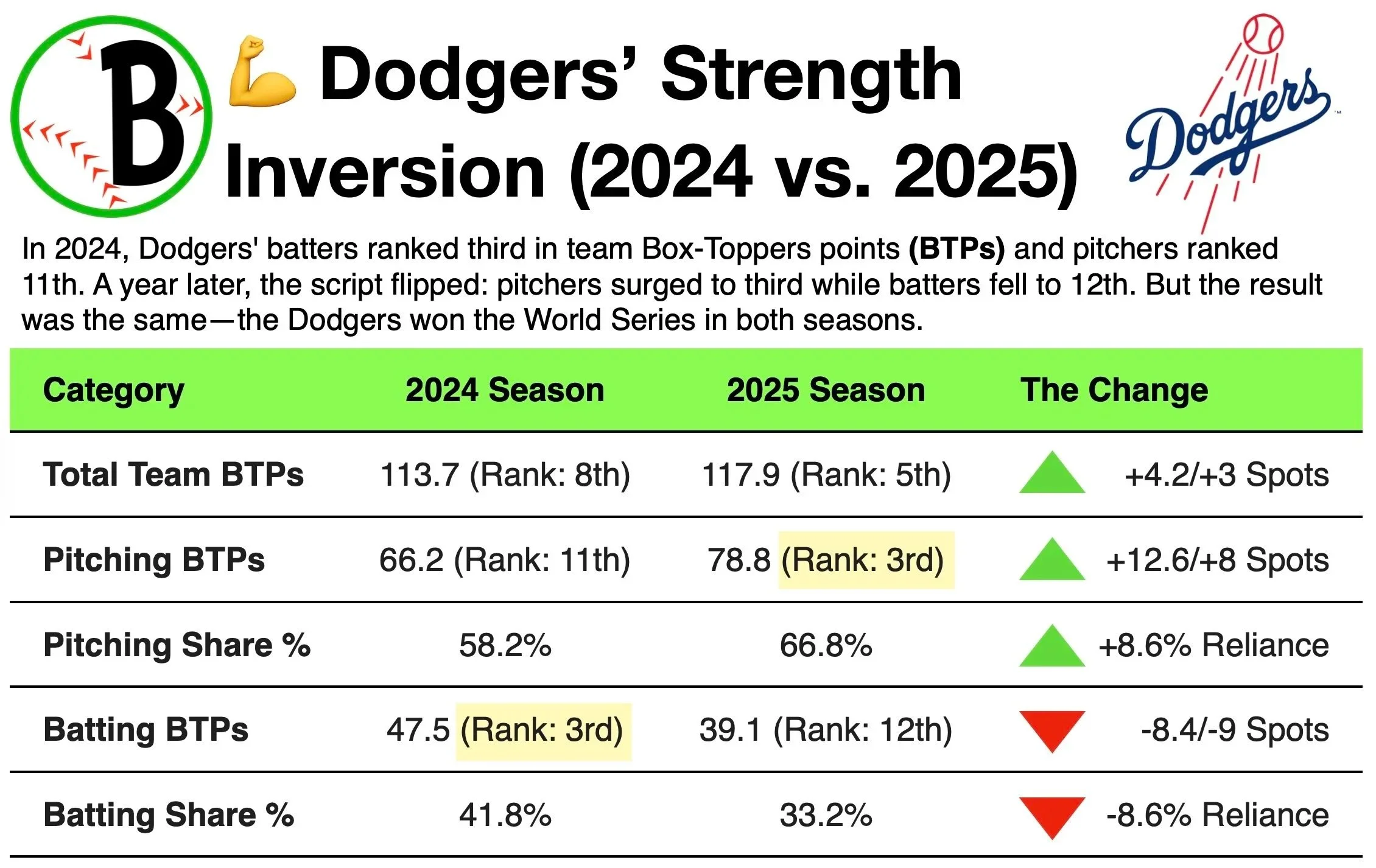
The Los Angeles Dodgers spent the last two seasons proving there is more than one way to win a World Series.
In 2024, they won the title with batters who ranked third in team Box-Toppers points and pitchers who ranked 11th. A year later, the script flipped: pitchers surged to third while batters fell to 12th.
It was a total inversion of identity, yet it resulted in the exact same hardware.
While conventional wisdom says pitching wins championships, the Box-Toppers data reveals a more fluid reality where teams can successfully pivot their entire competitive identity from one season to the next. By examining the balance of points earned by batters versus pitchers across all 30 clubs, we can see which teams are built to rake, which are built to shut down, and how those factors affected their success.
| Team |
Overall Rank |
Total BTP |
Batter rank |
Batter BTP |
Pitcher rank |
Pitcher BTP |
Batter % |
Pitcher % |
Wins |
Playoffs |
|---|---|---|---|---|---|---|---|---|---|---|
| Phillies | 1 | 131.4 | 15 | 37.0 | 1 | 94.4 | 28.2% | 71.8% | 96 | Y |
| Yankees | 2 | 127.1 | 2 | 53.5 | 7 | 73.6 | 42.1% | 57.9% | 94 | Y |
| Rangers | 3 | 123.6 | 16 | 36.7 | 2 | 86.9 | 29.7% | 70.3% | 81 | |
| Padres | 4 | 118.6 | 11 | 40.0 | 4 | 78.6 | 33.7% | 66.3% | 90 | Y |
| Dodgers | 5 | 117.9 | 12 | 39.1 | 3 | 78.8 | 33.2% | 66.8% | 93 | Y |
| Mariners | 6 | 117.6 | 10 | 41.7 | 5 | 75.9 | 35.5% | 64.5% | 90 | Y |
| Cubs | 7 | 117.6 | 1 | 55.1 | 13 | 62.5 | 46.9% | 53.1% | 92 | Y |
| Red Sox | 8 | 112.7 | 4 | 49.7 | 12 | 63.0 | 44.1% | 55.9% | 89 | Y |
| Brewers | 9 | 112.6 | 3 | 52.2 | 15 | 60.4 | 46.4% | 53.6% | 97 | Y |
| Blue Jays | 10 | 111.7 | 7 | 42.9 | 10 | 68.8 | 38.4% | 61.6% | 94 | Y |
| Tigers | 11 | 109.3 | 17 | 34.0 | 6 | 75.3 | 31.1% | 68.9% | 87 | Y |
| Royals | 12 | 107.4 | 14 | 38.2 | 8 | 69.2 | 35.6% | 64.4% | 82 | |
| Braves | 13 | 106.0 | 6 | 46.2 | 16 | 59.8 | 43.6% | 56.4% | 76 | |
| Mets | 14 | 104.5 | 8 | 42.7 | 14 | 61.8 | 40.9% | 59.1% | 83 | |
| Reds | 15 | 102.7 | 18 | 33.5 | 9 | 69.2 | 32.6% | 67.4% | 83 | Y |
| Astros | 16 | 101.9 | 9 | 42.7 | 17 | 59.2 | 41.9% | 58.1% | 87 | |
| Guardians | 17 | 96.3 | 22 | 31.5 | 11 | 64.8 | 32.7% | 67.3% | 88 | Y |
| Marlins | 18 | 84.9 | 19 | 33.5 | 20 | 51.4 | 39.5% | 60.5% | 79 | |
| Giants | 19 | 84.8 | 5 | 48.7 | 28 | 36.1 | 57.4% | 42.6% | 81 | |
| Angels | 20 | 84.6 | 13 | 38.5 | 24 | 46.1 | 45.5% | 54.5% | 72 | |
| Cardinals | 21 | 80.4 | 21 | 31.7 | 22 | 48.7 | 39.4% | 60.6% | 78 | |
| Rays | 22 | 80.0 | 27 | 26.5 | 18 | 53.5 | 33.1% | 66.9% | 77 | |
| Athletics | 23 | 77.4 | 23 | 31.2 | 23 | 46.2 | 40.3% | 59.7% | 76 | |
| Orioles | 24 | 76.5 | 26 | 27.7 | 21 | 48.8 | 36.2% | 63.8% | 75 | |
| Twins | 25 | 75.4 | 24 | 30.7 | 25 | 44.7 | 40.7% | 59.3% | 70 | |
| D‑backs | 26 | 74.9 | 25 | 30.7 | 26 | 44.2 | 41.0% | 59.0% | 80 | |
| Pirates | 27 | 69.7 | 30 | 17.5 | 19 | 52.2 | 25.1% | 74.9% | 71 | |
| White Sox | 28 | 64.4 | 20 | 33.0 | 29 | 31.4 | 51.2% | 48.8% | 60 | |
| Nationals | 29 | 60.1 | 29 | 23.7 | 27 | 36.4 | 39.4% | 60.6% | 66 | |
| Rockies | 30 | 47.0 | 28 | 24.9 | 30 | 22.1 | 53.0% | 47.0% | 43 |
The Dodgers shifted their focus from a more batting-heavy team in 2024 to a more pitching-dominated squad in 2025. However, their focus on batting in 2024 was largely driven by necessity.
In fact, before the 2024 season, the Dodgers stocked up on star pitchers and planned on having shut-down hurlers for the season. But injuries limited their frontline starters, forcing Dodgers manager Dave Roberts to piece together pitching rotations with relievers serving as short-term starters in bullpen games and nursing along starters in short-inning stints as they returned from the injured list.
Still, it worked. They won the World Series over the Yankees in five games.
In 2024, the Dodgers ranked eighth among all teams in total Box-Toppers points (113.7), but were one of eight teams in which batters earned more than 40 percent of the team’s points. Batters earned 47.5 points (41.8 percent of the team’s total), third-most among all teams, while pitchers earned 66.2 points (58.2 percent), 11th-most among all teams.
But in 2025, the script flipped as Dodgers pitching rebounded. The team earned 117.9 total Box-Toppers points, fifth among all teams. Pitchers earned 78.8 of those points (66.8 percent of the team’s total), third among all teams, while batters earned 39.1 points (33.2 percent), 12th among all teams.
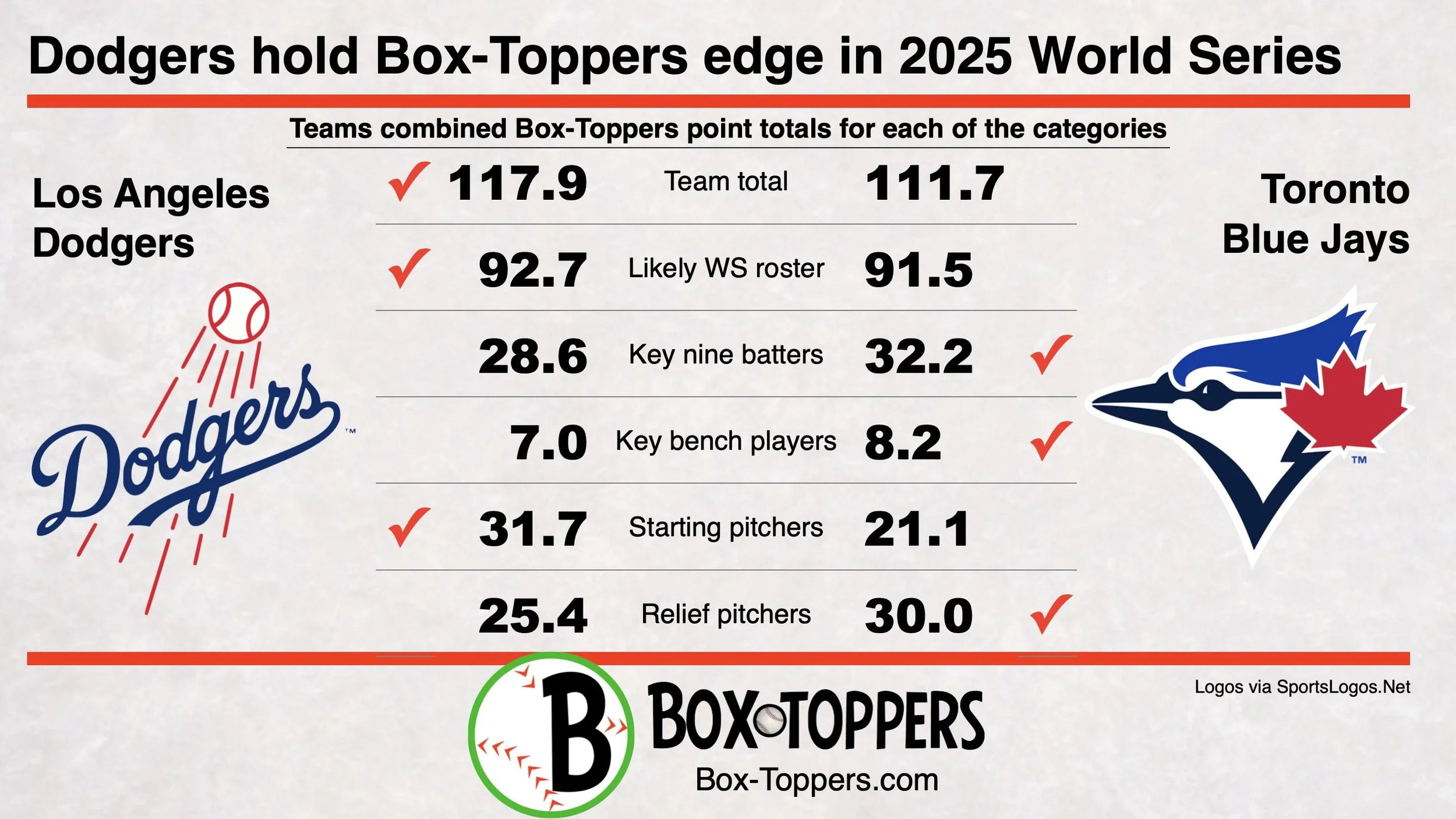
Box-Toppers 2025 World Series preview: Dodgers hold Box-Toppers points advantages over Blue Jays in 2025 World Series
Box-Toppers 2025 postseason postmortem: As Dodgers celebrate 2nd straight title, a Box-Toppers look back at 2025 postseason
And despite the different approach in 2025, the Dodgers won the World Series again, this time in seven games against the Toronto Blue Jays.
Dodgers pitchers’ gain of 12.6 Box-Toppers points from 2024 to 2025 was fueled by team leader Yoshinobu Yamamoto’s 17.7 Box-Toppers points, seventh overall and fourth among National League pitchers. In 2024, he earned just 6.4 points as he battled injury. Other notable Dodgers pitchers in 2025:
Clayton Kershaw, who in his final year before retirement earned 8.4 Box-Toppers points, a boost from the 2.0 he earned in his injury-shortened 2024 season.
Offseason pickup Blake Snell also bolstered the Dodgers’ pitching numbers in 2025, adding 7.0 points—even though it was less than the 15.7 he earned in 2024 with the Giants.
Andrew Heaney also oddly augmented the Dodgers’ pitching numbers, although his actual contributions to the team were minimal. Heaney earned 8.7 Box-Toppers points in 2025, all with the Pirates before being released Aug. 29. The Dodgers signed him Sept. 1, and though he only pitched one game for them, his 8.7 points are included in the Dodgers’ total since he was signed to the team at season’s end. His 8.7 points rank second among all Dodgers, behind only Yamamoto, despite his lack of contributions. Heaney, 34, announced his retirement in December.
While the Dodgers saw an increase in Box-Toppers points from pitchers from 2024 to 2025, team batters’ points decreased from 47.5 in 2024 to 39.1 in 2025. Shohei Ohtani led all Dodgers batters in 2024 with 11.0 Box-Toppers points in an explosive season in which he hit 54 home runs, stole 59 bases and scored 134 runs. But while he was arguably as productive offensively in 2025 (55 homers and 146 runs) he only earned 5.5 total Box-Toppers points in 2025 and only 3.5 as a batter—the other 2.0 were earned as a pitcher.
That means Ohtani’s points earned as a batter declined 7.5 points from 2024 to 2025 (from 11.0 to 3.5), which constitutes most of the 8.4-point drop in points earned by Dodgers’ batters in 2025.
Despite his elite offensive performance, Ohtani did not win Box-Toppers points as Player of the Game in team wins as often in 2025. There were five team wins in which Ohtani recorded a Box-Toppers game score of +3.0 or better, usually high enough for a batter to earn Player of the Game honors. But teammates with higher game scores—often the Dodgers’ resurgent pitchers of 2025—won the honor instead.
Teams with the most success in 2025, like the Dodgers, generally were more reliant on strong pitching. The top five overall teams in pitching points in 2025 were also among the top six teams in overall Box-Toppers points. Four of the five teams with the most pitching points made the postseason.
Box-Toppers’ five top pitching teams:
1. Philadelphia Phillies 94.4 (1st overall).
2. Texas Rangers 86.9 (3rd overall).
3. Los Angeles Dodgers 78.8 (5th overall).
4. San Diego Padres 78.6 (4th overall).
5. Seattle Mariners 75.9 (6th overall).
The Philadelphia Phillies led all teams in 2025 with their players accumulating 131.4 Box-Toppers points. Their pitchers accounted for 94.4 points, the most of any team, led by four pitchers who were among the top 10 NL pitchers in Box-Toppers points:
Zack Wheeler (20.1 points, 3rd overall, 2nd among NL pitchers).
Jesús Luzardo (17.4 points, 8th overall, 5th among NL pitchers).
Ranger Suárez (15.8 points, 10th overall, 6th among NL pitchers).
Cristopher Sánchez (15.4 points, 11th overall, 7th among NL pitchers).
Meanwhile, Phillies batters earned 37.0 of the team’s points in 2025, 15th-most among all teams. That means pitchers won 71.8 percent of the team’s points while batters won 28.2 percent. Only the Pittsburgh Pirates had a higher percentage of their Box-Toppers points generated by pitchers (74.9 percent).
Still, while the Phillies’ percentage of points earned by batters was second-lowest, the team’s Kyle Schwarber led NL batters with 12.0 Box-Toppers points, constituting nearly a third of the 37.0 points earned by Phillies batters in 2025.
How could a team with seemingly such strong pitching end up not making the postseason and finish with a .500 record?
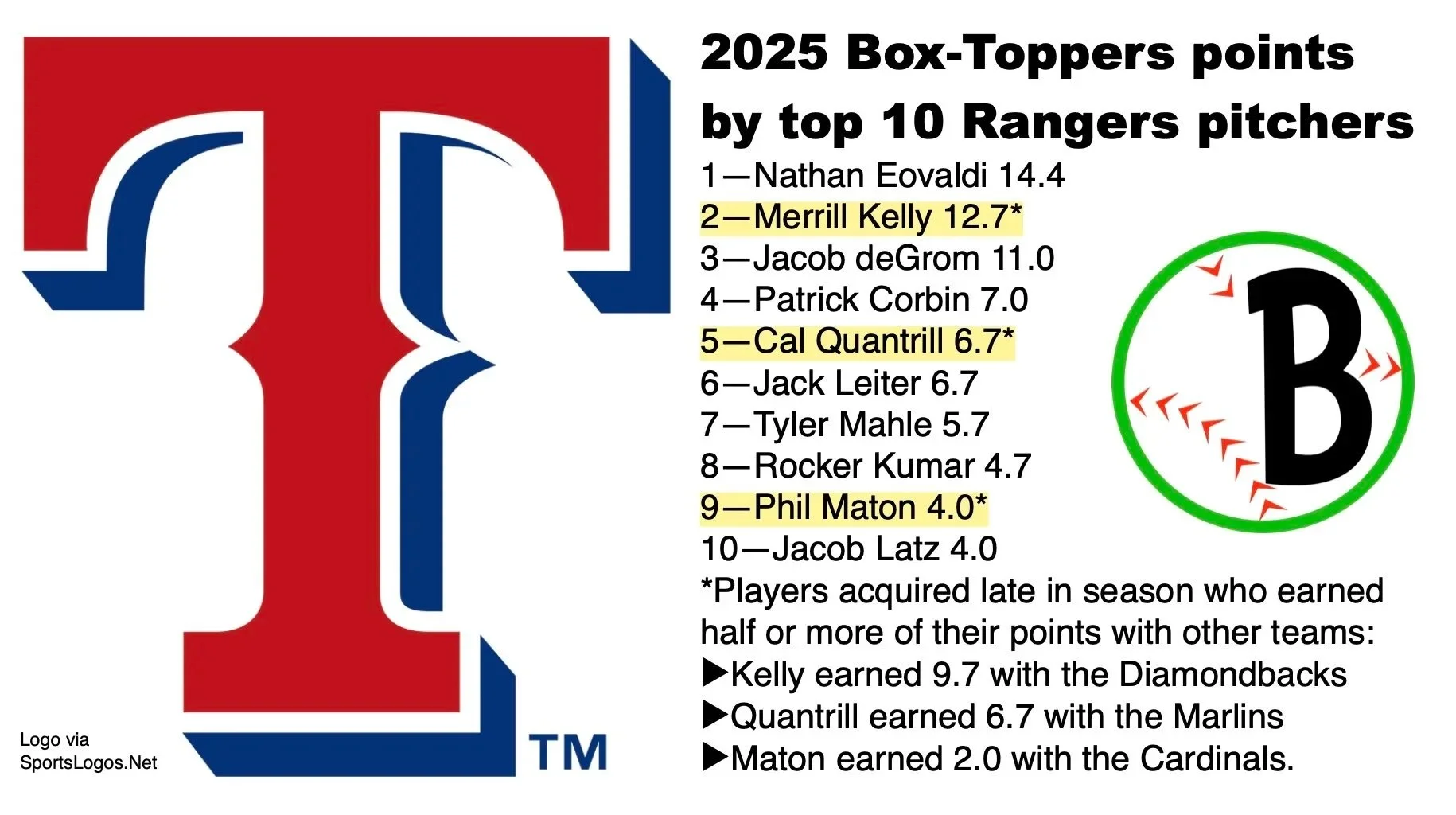
It’s because the Rangers acquired three pitchers who earned most of their points elsewhere earlier in the season:
Merrill Kelly earned 12.7 Box-Toppers points, but earned 9.7 with the Diamondbacks before his July 31 trade to the Rangers.
Cal Quantrill earned 6.7 points, but earned all of them with the Marlins before signing with the Rangers as a free agent on Sept. 7.
Phil Maton earned 4.0 points, but earned 2.0 with the Cardinals before his July 31 trade to the Rangers.
Subtracting the 18.4 points earned by the pitchers elsewhere would give Rangers pitchers 68.5 total points, dropping them from second to 10th place among teams.
These “phantom” pitching points boosted the Rangers beyond their team standing. They accumulated 123.6 Box-Toppers points, third overall and highest of any non-playoff team. They finished with 81 wins, tied for 16th among all teams. Subtracting the 18.4 points their pitchers earned for other teams would give them 105.2 points, putting them in a more fitting 13th place among all teams.
Still, despite the “phantom” points, the Rangers boasted two other pitchers with more than 10.0 Box-Toppers points in 2025:
Nathan Eovaldi (14.4 points, 14th overall, 6th among AL pitchers).
Jacob deGrom (11.0 points, 35th overall, 20th among AL pitchers).
The Rangers also had the third-highest share of their team points earned by pitchers (70.3 percent), behind the Pirates (74.9) and the Phillies (71.8).
The Dodgers had the third-most points earned by pitchers in 2025, 78.8 of their 117.9 total points. They ranked fifth overall and their 66.8 percent of points earned by pitchers was the eighth-most among all teams.
Five of the Dodgers’ top six players are full-time pitchers, led by Yoshinobu Yamamoto (17.7 points, first among Dodgers players, fourth among NL pitchers, and seventh overall). Other key Dodgers pitchers include:
Andrew Heaney (8.7 points, 2nd among Dodgers, 62nd overall), who earned all of his points with the Pirates before his release and joined the Dodgers late in the season and only pitched in one game. So while his points “officially” belong to the Dodgers since he was a member of the team, his contribution to the team was, in reality, insignificant.
Clayton Kershaw (8.4 points, 3rd among Dodgers, 72nd overall).
Blake Snell (7.0 points, 5th among Dodgers, 98th overall).
Shohei Ohtani earned 5.5 Box-Toppers points in 2025, 171st overall. He earned 2.0 of his points as a pitcher and 3.5 as a batter.
The Padres had the fourth-most points earned by pitchers, 78.6 of their 118.6 points. They ranked fourth overall and their 66.3 percent of points earned by pitchers was the ninth-most among all teams. Three of the Padres’ top-four players in 2025 were pitchers, led by:
Nick Pivetta (17.7 points, 6th overall).
Dylan Cease (8.7 points, 61st overall).
Mason Miller (7.0 points, 108th overall).
Manny Machado with 9.5 Box-Toppers points, ranked second among Padres players (and third among NL batters). Padres batters earned 40.0 points, 11th-most among all teams.
The Mariners had the fifth-most points earned by pitchers, 75.9 of their 117.6 points. They ranked sixth overall and their 64.5 percent of points earned by pitchers was the 10th-highest share among all teams.
Four Mariners pitchers, each with more than 10.0 Box-Toppers points, led the team in points in 2025. Three of them were among the top 10 AL pitchers in points in 2025:
Bryan Woo (18.0 points, 5th overall, 3rd among AL pitchers).
Luis Castillo (16.1 points, 9th overall, 4th among AL pitchers).
Logan Gilbert (13.1 points, 20th overall, 10th among AL pitchers).
George Kirby (11.0 points, 34th overall, 19th among AL pitchers).
While elite hitting is often a ticket to October—four of the top five batting teams made the postseason—it doesn't carry the same weight as elite pitching. The “quality gap” is clear when looking at overall team rankings: The top five pitching teams have a combined rank sum of just 19 (an average rank of 3.8). Meanwhile, the top five batting teams more than double that total with a sum of 45 (an average rank of 9.0). In short: the best pitching staffs anchor the very top of the leaderboard, while the best hitting teams sit further back in the pack.
Box-Toppers’ five top batting teams:
Chicago Cubs 55.1 (7th overall).
New York Yankees 53.5 (2nd overall).
Milwaukee Brewers 52.2 (9th overall).
Boston Red Sox 49.7 (8th overall).
San Francisco Giants 48.7 (19th overall).
The Cubs had the most points earned by batters in 2025, 55.1 of their 117.6 total points. They ranked seventh overall and their 46.9 percent of points earned by batters was fourth-most among all teams.
Four of the Cubs’ top eight players are batters, including two top 10 NL batters. They are led by Seiya Suzuki, whose 9.5 points is fourth-most on the team, behind pitchers Matthew Boyd (10.7), Jameson Taillon (10.1) and Cade Horton (9.7). Suzuki ranks fourth among NL batters, 52nd overall. Other key Cubs batters include:
Pete Crow-Armstrong (9.5 points, 5th among Cubs, 5th among NL batters, 54th overall).
Ian Happ (6.0 points, 7th among Cubs, 138th overall).
Carson Kelly (6.0 points, 8th among Cubs, 151st overall).
The Yankees had the second-most points earned by batters in 2025, most among American League teams, 53.5 of their 127.1 total points. They ranked second overall and their 42.1 percent of points earned by batters was the ninth-most among all teams.
Four of the Yankees’ top nine players are batters, led by Jazz Chisholm Jr., whose 7.2 points was fifth among all Yankees behind pitchers Max Fried (14.4), Carlos Rodón (13.7), Will Warren (9.4) and Cam Schlittler (7.4). Chisholm’s 7.2 points ranked 12th among AL batters and 95th overall. The other three batters among the Yankees’ top nine players:
Trent Grisham (7.2 points, 6th among Yankees, 96th overall).
Aaron Judge (6.5 points, 8th among Yankees, 127th overall). While Judge put up impressive offensive numbers and was voted AL Most Valuable Player, he was often beaten by teammates with higher Box-Toppers game scores for Player of the Game honors.
Cody Bellinger (5.9 points, 9th among Yankees, 158th overall).
The Brewers had the third-most points earned by batters in 2025, 52.2 of their 112.6 total points. They ranked ninth overall and their 46.4 percent of points earned by batters was fifth-most among all teams.
Six of the Brewers’ top 10 players are batters, led by Christian Yelich (11.2 points, second among Brewers players, second among NL batters and 33rd overall). Other key Brewers batters include:
Isaac Collins (5.5 points, 6th among Brewers, 179th overall).
Jackson Chourio (5.0 points, 7th among Brewers, 189th overall).
Rhys Hoskins (4.5 points, 8th among Brewers, 225th overall).
William Contreras (4.0 points, 9th among Brewers, 248th overall).
Jake Bauers (4.0 points, 10th among Brewers, 253rd overall).
The Red Sox had the fourth-most points earned by batters in 2025, 49.7 of their 112.7 total points. They rank eighth overall and their 44.1 percent of points earned by batters was seventh among all teams. Five of the Red Sox’s top nine players are batters, led by:
Wilyer Abreu (8.5 points, 3rd among Red Sox, 6th among AL batters, 67th overall).
Trevor Story (8.0 points, 4th among Red Sox, 10th among AL batters, 77th overall).
Nathaniel Lowe (7.0 points, 6th among Red Sox, 111th overall).
Ceddanne Rafaela (6.5 points, 7th among Red Sox, 131st overall).
Jarren Duran (6.0 points, 9th among Red Sox, 145th overall).
The Giants had the fifth-most points earned by batters in 2025, 48.7 of their 84.8 total points. They rank 19th overall and their 57.4 percent of points earned by batters was first among all teams.
The Giants are one of only three teams in which the majority of the Box-Toppers point total came from batters, usually the sign of a team that wins fewer games. The others:
The Colorado Rockies, whose 53.0 percent ranked 2nd (24.9 of their 47.0 total points came from batters).
The Chicago White Sox, whose 51.2 percent ranked 3rd (33.0 of their 64.4 total points came from batters).
Notably, the Rockies and White Sox won the fewest games among all teams—the Rockies 43 and the White Sox 60. But the Giants won 81 games, finishing with a .500 record, and were tied with the 16th-best win total among all teams.
Five of the Giants’ top seven players are batters. Behind the top two, pitchers Robbie Ray (9.4 points) and Logan Webb (9.0 points), they are:
Willy Adames (8.5 points, 3rd among Giants, 6th among NL batters, 66th overall).
Rafael Devers (7.7 points, 4th among Giants, 7th among NL batters, 84th overall).
Jung Hoo Lee (6.5 points, 5th among Giants, 134th overall).
Matt Chapman (5.0 points, 6th among Giants, 186th overall).
Wilmer Flores (5.0 points, 7th among Giants, 202nd overall).
In 2025, teams that were over-reliant on a single facet of their roster often found themselves stuck in the middle of the pack—or worse.
The “imbalance penalty” was particularly harsh for teams dependent on their batters; the five clubs with the highest percentage of points from batters stumbled to a dismal average overall rank of 18.6, weighed down by bottom-tier finishes from the Rockies and White Sox.
Pitching-heavy teams fared better—and some, like the Phillies, still rode their high pitching share to the top of the league. But even for this group, over-reliance carried a risk: the five clubs most dependent on their arms averaged an overall rank of 11.4, dragged down by the 27th-ranked Pirates.
Ultimately, the data suggests that while you can occasionally win with just pitching, it is almost impossible to “slug” your way around a deficient rotation.
Pittsburgh Pirates: 74.9% (52.2 of 69.7 pts). Overall rank: 27th. (The Pirates were led by Paul Skenes, whose 21.1 Box-Toppers points led NL pitchers and represented 40.4% of the team’s pitching points and 30.3% of the team’s overall points.)
Philadelphia Phillies: 71.8% (94.4 of 131.4 pts). Overall rank: 1st.
Texas Rangers: 70.3% (86.9 of 123.6 pts). Overall rank: 3rd.
Detroit Tigers: 68.9% (75.3 of 109.3 pts). Overall rank: 11th.
Cincinnati Reds: 67.4% (69.2 of 102.7 pts). Overall rank: 15th.
San Francisco Giants: 57.4% (48.7 of 84.8 pts). Overall rank: 19th.
Colorado Rockies: 53.0% (24.9 of 47.0 pts). Overall rank: 30th.
Chicago White Sox: 51.2% (33.0 of 64.4 pts). Overall rank: 28th.
Chicago Cubs: 46.9% (55.1 of 117.6 pts). Overall rank: 7th.
Milwaukee Brewers: 46.4% (52.2 of 112.6 pts). Overall rank: 9th.
The San Francisco Giants had the biggest variance in ranking between batters (fifth with 48.7 points) and pitchers (28th with 36.1). That 23-spot variance was nine places more than the next-highest:
Philadelphia Phillies—14 spots: 15th among batters (37.0), first among pitchers (94.4).
Texas Rangers—14 spots: 16th among batters (36.7), second among pitchers (86.9).
Chicago Cubs—12 spots: first among batters (55.1), 13th among pitchers (62.5).
Milwaukee Brewers—12 spots: third among batters (52.2), 15th among pitchers (60.4).
Teams with strong pitching were more likely to make the postseason in 2025 than teams that relied more heavily on batters.
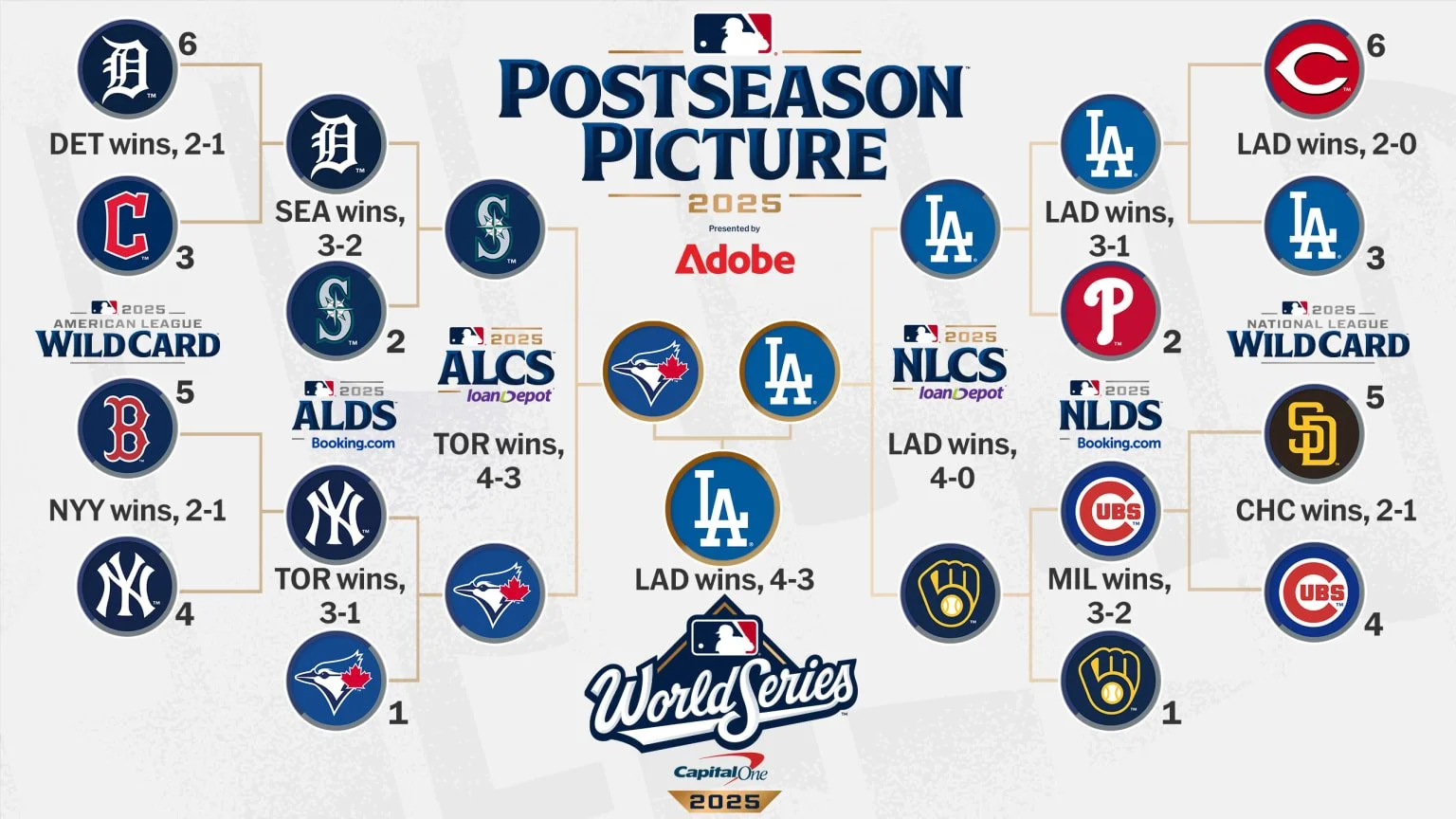
Among the teams that ranked in the top 10 in Box-Toppers points earned by pitchers, eight made the postseason. However, among teams that ranked in the top in points earned by batters, only six made the postseason.
Among the top 10 teams in pitching, only two did not make the postseason:
The Texas Rangers, second in pitching points (86.9). However, as previously noted, many of those were “phantom” points, earned by players when they were on other teams who finished the season with the Rangers.
The Kansas City Royals, eighth in pitching points (69.2). The Royals were 12th overall in team points (107.4) and their 82 wins ranked 15th overall.
Among the top 10 in batting, four did not make the postseason:
The San Francisco Giants, fifth in batting points (48.7).
The Atlanta Braves, sixth in batting points (46.2). The Braves were 13th overall in team points (106.0) and their 76 wins ranked tied for 22nd overall.
The New York Mets, eighth in batting points (42.7). The Mets were 14th overall in team points (104.5) and their 83 wins ranked tied for 13th overall.
The Houston Astros, ninth in batting points (42.7). The Astros were 16th overall in team points (101.9) and their 87 wins ranked tied for 11th overall.
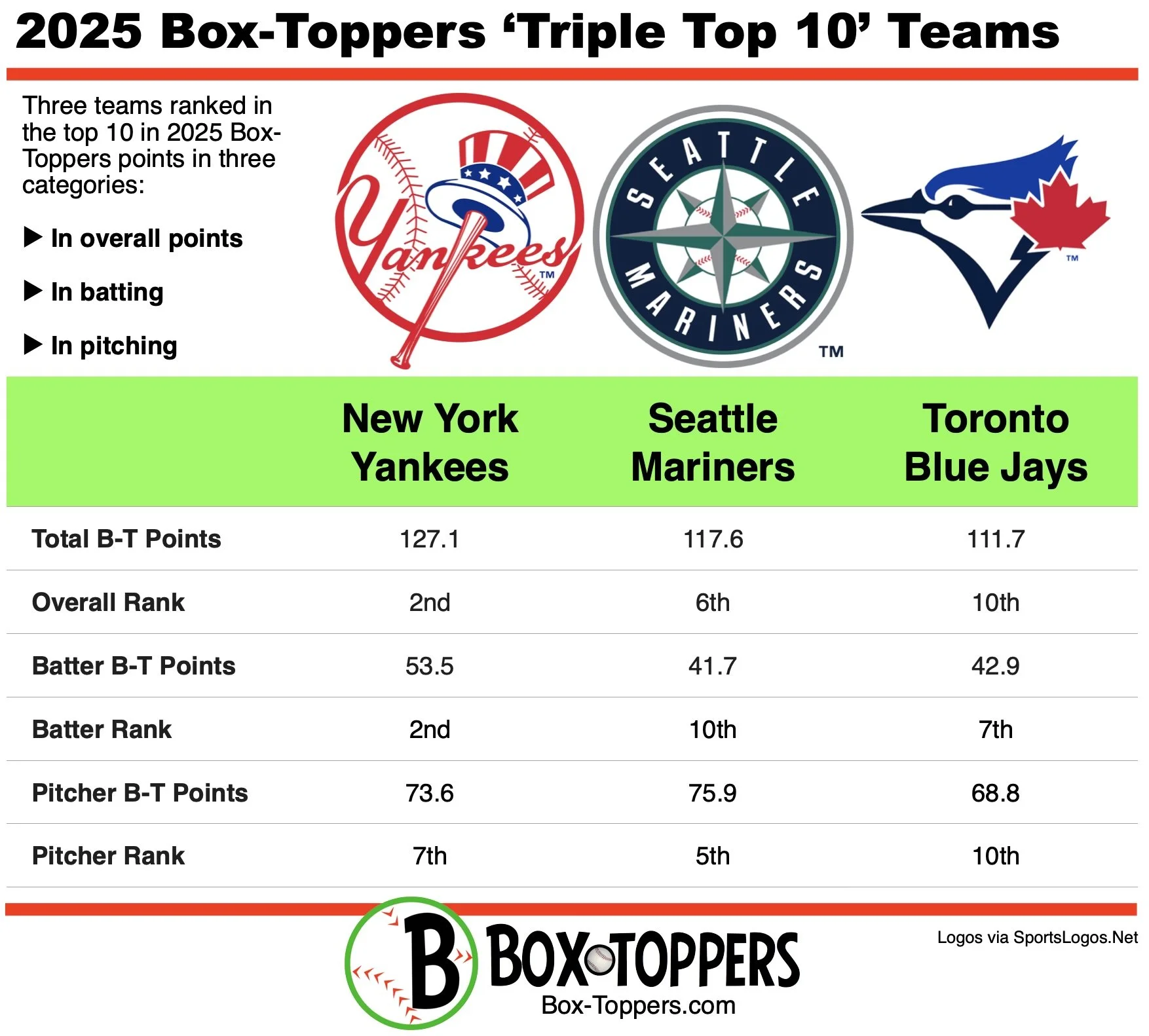
Only three teams rank in the overall top 10 teams in Box-Toppers points, the top 10 among batters and the top 10 among pitchers. All three made the postseason:
Seattle Mariners: Sixth overall (117.6 points), 10th among batters (41.7) and fifth among pitchers (75.9). (The Mariners lost to the Blue Jays in the AL Championship Series.)
New York Yankees: Second overall (127.1 points), second among batters (53.5) and seventh among pitchers (73.6). (The Yankees lost to the Blue Jays in the AL Division Series.)
Toronto Blue Jays: 10th overall (111.7 points), seventh among batters (42.9) and 10th among pitchers (68.8). (The Blue Jays lost to the Dodgers in the World Series.)
Box-Toppers tracks who most helps their team win the most games. Using standard box score statistics, Box-Toppers uses a simple formula to determine a Player of the Game for each Major League Baseball game played. That player is the person who contributed most to his team’s win. In regular season games, players earn 1.0 Box-Toppers point for being named Player of the Game and can earn bonus points for being Player of the Day or top player or batter in their league for the day. (No Box-Toppers points are awarded in postseason games.)
Box-Toppers strives for accuracy. See a mistake in a post? A wrong name, wrong team, grammar error, spelling goof, etc.? Thanks for pointing it out! Contact Box-Toppers here. Let's fix it and make it right.
For additional updates, follow Box-Toppers on Bluesky or Twitter (X).
Seven of the 20 batters winning Silver Slugger Awards in 2025 were also among the leaders at their positions in 2025 Box-Toppers point totals.
The awards are given to the top batter in each position in both leagues, voted on by Major League Baseball coaches and managers. Box-Toppers, analyzing traditional box scores, tracks which players most help their teams win the most games, awarding points for the top player in each game.
Read MoreBox-Toppers favors the top-seed Milwaukee Brewers over the defending World Series champion Los Angeles Dodgers in the 2025 National League Championship Series.
The Dodgers are the third-seeded NL playoff team but rank higher than the Brewers in final 2025 Box-Toppers team rankings—in fifth place overall with their players accumulating 117.9 Box-Toppers points during the season, third among NL teams and most among surviving postseason teams. Brewers players have a combined 112.6 Box-Toppers points in 2025, ninth among all teams and fifth among NL teams.
Read MoreBrewers pitcher Jacob Misiorowski is Box-Toppers Player of the Game in Saturday’s National League Division Series Game 5, as the Milwaukee Brewers win the series, eliminating the Chicago Cubs.
Misiorowski struck out three over four innings of middle relief, allowing one run, three hits, no walks and earning the win.
Read MoreMariners pitcher George Kirby is Box-Toppers Player of the Game in Friday’s American League Division Series Game 5, as the Seattle Mariners win the series, eliminating the Detroit Tigers.
The game took six extra innings to finish and was tied 2-2 from the seventh inning until Jorge Polanco of the Mariners hit a single with the bases loaded in the bottom of the 15th inning to win it, 3-2. However, Player of the Game winner Kirby’s contributions came entirely within the game’s first six innings.
Read MoreDodgers pitcher Tyler Glasnow and Cubs pitcher Matthew Boyd are Box-Toppers Player of the Game winners in Thursday’s two National League Division Series games.
The Los Angeles Dodgers eliminate Box-Toppers’ top-ranked team, the Philadelphia Phillies, in one of the series. The Chicago Cubs meanwhile force a deciding Game 5 Saturday with the Milwaukee Brewers, with a win to tie that series.
Read MoreJavier Báez of the Tigers tops players in Wednesday’s four League Division Series playoff games.
Meanwhile, the Toronto Blue Jays advance to the American League Championship Series, eliminating the New York Yankees in four games in the AL Division Series.
Read MoreMariners pitcher Logan Gilbert and Aaron Judge of the Yankees are Box-Toppers Player of the Game winners in Tuesday’s two American League Division Series games.
Read MoreBlue Jays pitcher Trey Yesavage tops players in Sunday’s two American League Division Series games.
Meanwhile, Jorge Polanco of the Mariners is Box-Toppers Player of the Game in the other ALDS Game 2.
Read MoreBox-Toppers tracks who most helps their team win the most games. Using standard box score statistics, Box-Toppers uses a simple formula to determine a Player of the Game for each Major League Baseball game played. That player is the person who contributed most to his team’s win. Players earn Box-Toppers points for being named Player of the Game and can earn bonus points for being Player of the Day or top player or batter in their league for the day.