

In 2026—for the 20th straight year—baseball writers maintained their blockade against Hall of Fame candidates tied to performance-enhancing drugs.
This year’s results officially extinguished the candidacy of Manny Ramírez after a decade on the ballot and once again stalled the progress of Álex Rodríguez as he reaches his five-year midpoint.
These two are among eight shown in the graphic elsewhere on this page who are baseball’s “former future Hall of Famers,” players discussed as locks—sure-thing inductees whose eventual election was treated as a foregone conclusion. But through their choices, that “future” status didn't just fail to arrive; it was rendered in the past tense. The inevitability of their immortality didn't just stall; it was essentially revoked. They became baseball’s modern “Eight Men Out,” a group that reached the pinnacle of performance only to find the gates of Cooperstown closed.
While our Box-Toppers metrics show these players to be among the best in the history of baseball, I’ve always maintained that their disregard for the integrity of the game disqualifies them from induction. The data is undeniable, but the compromise to fair play remains a permanent asterisk.
A-Rod, Manny among top 3 batters in Box-Toppers era
As the last two prominent PED-associated candidates remaining on the writers' ballot, the continued exclusion of Ramírez and Rodríguez is even more striking because they are two of the top three batters in the Box-Toppers tracking era.
Since tracking began in 1995, Rodríguez and Ramírez rank second and third, respectively, among all batters in career Box-Toppers points. They trail only Albert Pujols (207.8 points). Rodríguez holds the second-place spot with 187.0 points, while Ramírez sits in third with 166.2 points (a total that projects to 172 when accounting for his full career).
By maintaining the “PED Wall,” baseball writers are effectively barring two of the three most productive hitters of the last 30 years.
’PED Wall’ built in 2007 still stands 20 years later
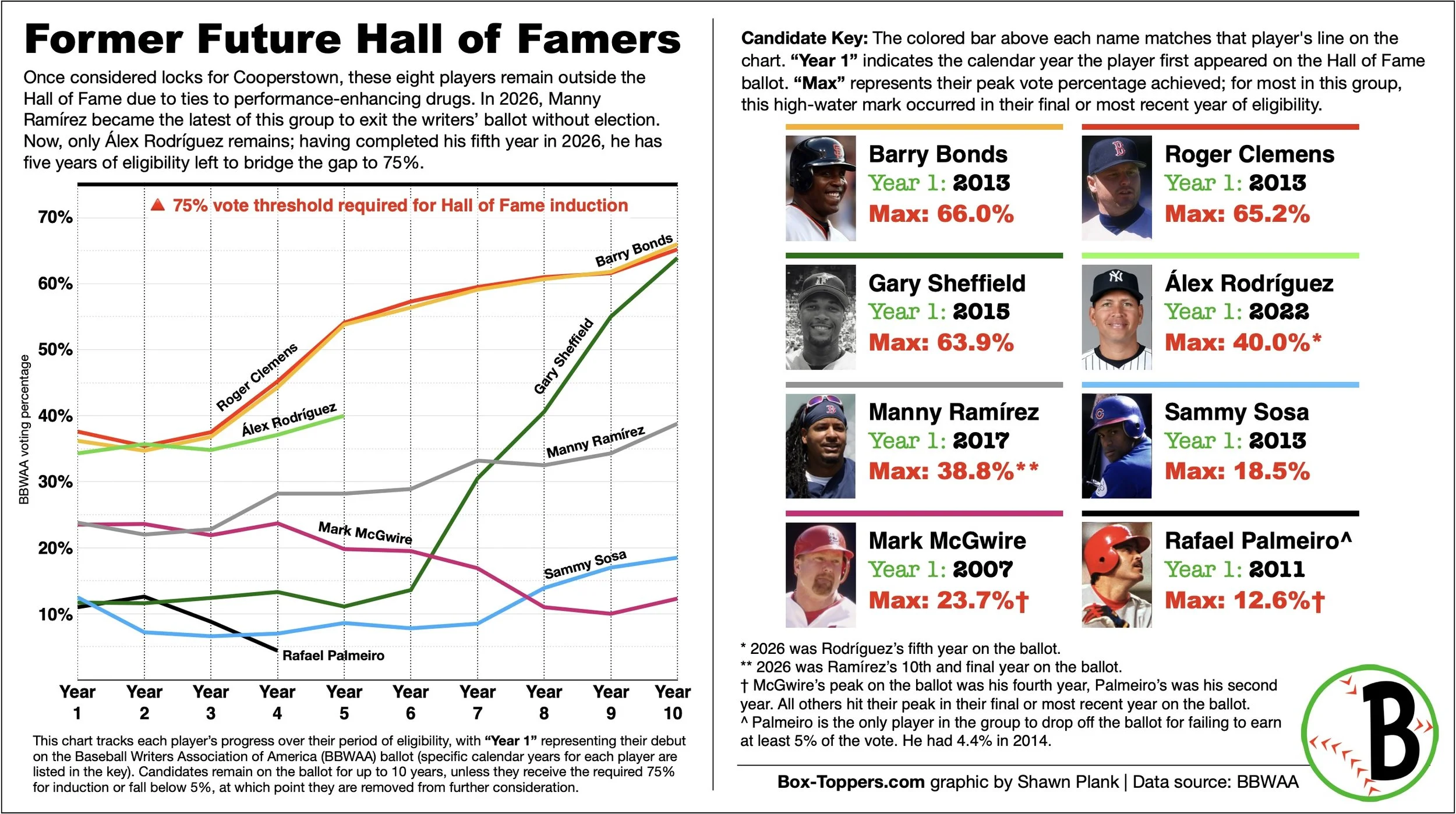
The chart on this page tracks the visual history of how the “PED Wall” has stood tall since Mark McGwire first appeared on the ballot in 2007.
While the voting trajectories show a clear and consistent rejection by the voters of the Baseball Writers Association of America (BBWAA), the on-field data tells a different story—one of historic, all-time dominance. To understand exactly what is being left out of Cooperstown, we have to look at their career Box-Toppers point totals.
Excluded players among all-time leaders in Box-Toppers points
Box-Toppers points of former future Hall of Famers
Below are the career Box-Toppers metrics for eight players whose Hall of Fame cases were stalled by PED ties. Because each debuted before the advent of Box-Toppers tracking in 1995, the table includes their career rank at the end of 2025, actual points earned during the tracking era (BTP), and a projection (Proj) for their entire career span.| Rank | Player | BTP | Proj | Career span |
|---|---|---|---|---|
| 10 | Álex Rodríguez | 187.0 | 187* | 1994‑2016 |
| 17 | Manny Ramírez | 166.2 | 173 | 1993‑2011 |
| 19 | Roger Clemens | 164.8 | 312 | 1984‑2007 |
| 27 | Barry Bonds | 152.2 | 230 | 1986‑2007 |
| 51 | Gary Sheffield | 124.1 | 155 | 1988‑2009 |
| 68 | Sammy Sosa | 113.2 | 135 | 1989‑2007 |
| 177 | Rafael Palmeiro | 77.9 | 107 | 1986‑2005 |
| 190 | Mark McGwire | 76.3 | 129 | 1986‑2001 |
For Pitchers: Projections are based on Box-Toppers points per strikeout. For example, Roger Clemens earned 164.8 points and 2,471 strikeouts from 1995–2007 (0.0667 points per K). Applying that ratio to his 2,201 strikeouts from 1984–1994 adds a projected 147 points, bringing his career total to 312.
For Batters: Projections are based on Box-Toppers points per home run, using the same ratio-based calculation to estimate value for the pre-1995 portion of their careers.
* Though Álex Rodríguez debuted in 1994, analysis of his 17 games that season indicates he earned no Box-Toppers Player of the Game honors. Consequently, his 187.0 points earned since 1995 represent his full career total.
When viewing on the Box-Toppers.com website, this chart is sortable. Click or tap the column header to re-sort the chart by the values in that column. Refresh page to restore chart to default view.
Because Box-Toppers tracking began in 1995, many players in this group—most notably Roger Clemens and Barry Bonds—had significant portions of their prime careers in the “pre-tracking” era. To provide a complete picture of their value, I have calculated a projected career total for these players. This was done by establishing their "points-per-stat" efficiency (such as points earned per strikeout for pitchers) during the tracked portion of their careers and applying that ratio to their pre-1995 statistics.
The data in the table illustrates the level of production achieved by these candidates. For example, Roger Clemens projects to 312 career Box-Toppers points. (To put that in perspective, the current all-time leader in tracked points is Randy Johnson at 282.5—although it must be noted that Johnson’s career also preceded Box-Toppers tracking, and his own projected career total of 388 remains the gold standard.) By maintaining the “PED Wall,” the Hall of Fame is essentially excluding the most productive players our metrics have ever seen.
Final thoughts: The last man standing
The trajectories in these charts represent more than just numbers; they represent the varied ways the “PED Wall” has claimed the Hall of Fame candidacies of the game’s elite.
We see the extremes of the blockade in players like Rafael Palmeiro, who plummeted off the ballot in just four years after falling below the 5 percent minimum support, and Gary Sheffield, who saw a massive, late-career surge in voting only to run out of time at the 10-year limit. Even Manny Ramírez, whose statistical brilliance during the tracking era was undeniable, never truly found a foothold with the writers.
(To see precise year-by-year vote percentages of each of the eight players, see the chart, “PED-tied players’ Hall of Fame votes by year” elsewhere on this page.)
As we look toward 2027, the era of the “PED Eight” is nearly over. With the exits of Bonds, Clemens, Sammy Sosa, Sheffield, and now Ramírez, Álex Rodríguez remains as the final test of this 20-year stalemate. A-Rod has five years of eligibility remaining to see if his 40 percent support can bridge the massive gap to 75 percent.
However, if the last two decades are any indication, the writers have made their position clear. While these charts and tables illustrate the greatest collection of talent ever excluded from Cooperstown, they also serve as a permanent record of the cost of compromising the game’s integrity. The stats are legendary, but the wall remains standing.
About Box-Toppers
Box-Toppers tracks who most helps their team win the most games. Using standard box score statistics, Box-Toppers uses a simple formula to determine a Player of the Game for each Major League Baseball game played. That player is the person who contributed most to his team’s win. In regular season games, players earn 1.0 Box-Toppers point for being named Player of the Game and can earn bonus points for being Player of the Day or top player or batter in their league for the day. (No Box-Toppers points are awarded in postseason games.)
Box-Toppers strives for accuracy. See a mistake in a post? A wrong name, wrong team, grammar error, spelling goof, etc.? Thanks for pointing it out! Contact Box-Toppers here. Let's fix it and make it right.
For additional updates, follow Box-Toppers on Bluesky or Twitter (X).
Related:
PED-tied players’ Hall of Fame votes by year
Here are the year-by-year Hall of Fame voting percentages for the eight players whose enshrinement has been thwarted by their PED ties. None received the necessary 75% support from baseball writers for induction in any year on the ballot.| Ballot Year |
Barry Bonds |
Roger Clemens |
Gary Sheffield |
Álex Rodríguez |
Manny Ramirez |
Sammy Sosa |
Mark McGwire |
Rafael Palmeiro |
|---|---|---|---|---|---|---|---|---|
| Year 1 | 36.2% | 37.6% | 11.7% | 34.3% | 23.8% | 12.5% | 23.5% | 11.0% |
| Year 2 | 34.7% | 35.4% | 11.6% | 35.7% | 22.0% | 7.2% | 23.6% | 12.6% |
| Year 3 | 36.8% | 37.5% | 12.4% | 34.8% | 22.8% | 6.6% | 21.9% | 8.8% |
| Year 4 | 44.3% | 45.2% | 13.3% | 37.1% | 28.2% | 7.0% | 23.7% | 4.4%* |
| Year 5 | 53.8% | 54.1% | 11.1% | 40.0% | 28.2% | 8.6% | 19.8% | — |
| Year 6 | 56.4% | 57.3% | 13.6% | — | 28.9% | 7.8% | 19.5% | — |
| Year 7 | 59.1% | 59.5% | 30.5% | — | 33.2% | 8.5% | 16.9% | — |
| Year 8 | 60.7% | 61.0% | 40.6% | — | 32.5% | 13.9% | 11.0% | — |
| Year 9 | 61.8% | 61.6% | 55.0% | — | 34.3% | 17.0% | 10.0% | — |
| Year 10 | 66.0% | 65.2% | 63.9% | — | 38.8% | 18.5% | 12.3% | — |
*Palmeiro fell off the ballot after Year 4 for receiving less than 5% of the vote.
“Year 1” represents each players’ debut on the Baseball Writers Association of America (BBWAA) ballot. Here are the years each player debuted:
2007—McGwire
2011—Palmeiro
2013—Bonds, Clemens, Sosa
2015—Sheffield
2017—Ramirez
2022—Rodríguez
Candidates remain on the ballot for up to 10 years, unless they receive the required 75% for induction or fall below 5%, at which point they are removed from further consideration.
When viewing on the Box-Toppers.com website, this chart is sortable. Click or tap the column header to re-sort the chart by the values in that column. Refresh page to restore chart to default view.